The Good Teacher Award to Pauli Losoi
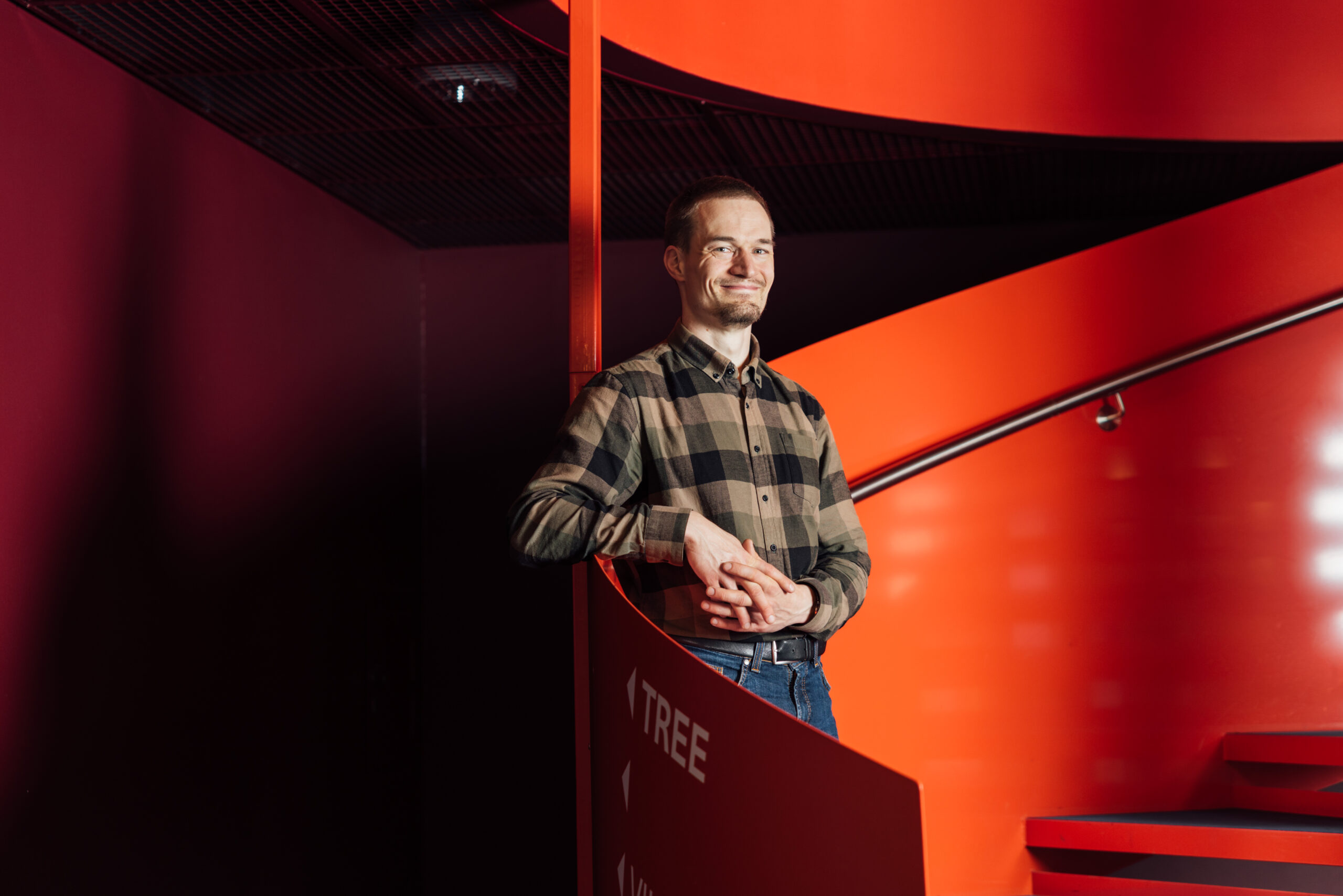
The Finnish Foundation for Technology Promotion has awarded the Good Teacher Award 2026 to University Lecturer Pauli Losoi. Losoi teaches thermodynamics, fluid mechanics and heat transfer at Tampere University. According to students, his teaching reflects both enthusiasm for the subject matter and a strong commitment to providing the highest possible quality of teaching.
University Lecturer Pauli Losoi is deeply interested in the subjects he teaches. That passion is also reflected in the feedback he receives from students.
“The subjects I teach are very interesting to me personally. Apparently, students have noticed that the teacher gets quite excited about these topics,” Losoi laughs.
Losoi found his way into teaching through research work. After graduating with a Master of Science in Technology, he took up the opportunity to pursue postgraduate studies and began working as a doctoral researcher at Tampere University. Teaching was also part of the role.
“As I got familiar with the world of teaching, I realised that this is actually quite enjoyable,” Losoi says.
When a position for a university lecturer opened up at the university during the final stages of his doctoral studies, Losoi decided to apply. He has now worked as a full-time teacher for three years.
Losoi’s enthusiasm for his work also impressed the award committee.
“Pauli Losoi’s teaching combines pedagogical innovation, technological understanding and genuine student-centredness in an exceptional way. What particularly impressed us at the foundation was his ability to receive feedback and develop his courses in ways that genuinely reflect students’ wishes,” says Jorma Kyyrä, Chair of TES’s Grant Committee.
Learning Through Mistakes
Losoi’s teaching combines traditional teaching methods with continuous course development. Alongside lectures, exercise sessions and exams, he closely follows how students learn and where they encounter difficulties.
Students have particularly praised Losoi’s exam revision system. After an exam, students can review their answers, take the feedback into account, correct their mistakes and regain part of the lost points. The practice ensures that students understand where they went wrong.
The revision process also helps Losoi improve his teaching. He tracks recurring mistakes among students and uses these observations when designing course exercises and refining the focus of his teaching.
Translating Real-world Problems into the Language of Mathematics
Losoi structures his teaching so that students can follow the progression of the course. Lectures often begin with a recap of the previous week’s topics, and new concepts are built on previously learned material. This creates a clear and logical progression throughout the course.
It is also important to him that students understand how mathematics relates to real-world phenomena.
“Engineering education can easily become too focused on ready-made models and calculations. Before anything can be calculated, you first need to understand how a real-world phenomenon is transformed into a mathematical model,” Losoi explains.
Losoi helps students understand how real-world problems are translated into the language of mathematics — and how mathematical solutions, in turn, relate back to practical situations. According to him, this connection helps students develop a deeper understanding of the subjects being taught.
A Good Teacher Actively Keeps Up With the Times
Losoi emphasises the importance of fundamental skills in his teaching. On his courses, exams are still completed on paper and students are provided with all necessary materials in advance. This ensures that students practise independent problem-solving skills.
This does not mean that new technologies — including artificial intelligence — would not have a role in education. Losoi actively updates his teaching based on new research and technological developments, and course examples and exercises are often built around current phenomena. He believes that AI will gradually change teaching.
“Ideally, students should first develop their own understanding of the subject before artificial intelligence is used as a support tool.”
Losoi thinks that, at its best, AI serves as a tool for ideation, information retrieval and refining one’s work. He compares adopting new tools to athletic training: the fundamentals must be mastered before increasing the level of challenge.
“You can’t start weightlifting training with a hundred-kilo lift. First you practise the movement patterns with a training bar. Only after that do you move on to weights.”
The Most Rewarding Moments Are Students’ Insights
For Losoi, the most important aspect of teaching is that students develop a genuine understanding of the subjects being taught. He emphasises that learning requires concentration, time and personal commitment.
Amid constant digital distractions, students need more self-discipline than ever before. This is something Losoi also emphasises during lectures: students should come to lectures genuinely ready to learn and engage with the subject.
The most rewarding moments in his work are those when a student suddenly understands something new.
“I can almost see the light bulb turning on above the student’s head. Those moments are hard to beat.”
The Good Teacher Award is granted by the Finnish Foundation for Technology Promotion to a person working in teaching duties at a university of technology or a technical faculty at a university. The prize amount is €10,000.
At the beginning of each year, the foundation invites Finnish student associations in the field of technology to nominate suitable candidates for the Good Teacher Award. When selecting candidates, the foundation asks nominators to pay attention to factors such as the content and quality of teaching, the use of the latest research knowledge, and the ability to inspire and motivate students.
Uusimmat artikkelit

Tänään juhlimme eurooppalaista säätiöpäivää!
Tänään juhlimme eurooppalaista säätiöpäivää! Tämän vuoden teema on Ihmisten ja planeetan parhaaksi ja mikäpä voisikaan kuvailla Tekniikan edistämissäätiön tavoitetta paremmin. Säätiömme tukee tutkimusta ja tutkijoita, joiden työllä on potentiaalia kehittyä tulevaisuuden läpimurtoteknologioiksi. Uskomme näiden tulevaisuuden teknologioiden olevan avainasemassa aikamme suuriin haasteisiin vastaamisessa kestävästi. Vuonna 2025 jaoimme lähes miljoona euroa tekniikan alan tutkimukseen Suomessa. Suurin…

Vaihto-opinnot yhdistivät energiaa, ympäristöä ja lääketiedettä
Vaihto-opinnot yhdistivät energiaa, ympäristöä ja lääketiedettä Kuva: Kevin Hede Kestäviä teknisiä ratkaisuja syntyy, kun eri alojen osaamista uskalletaan yhdistää. Tämä oli tärkein oivallukseni Erasmus-vaihdossa Padovan yliopistossa Italiassa keväällä 2026. Opintoni veivät minut uusiutuvan energian ja ympäristösuunnittelun lisäksi yllättävän aiheen äärelle: 3D-bioprinttaukseen ja syöpätutkimukseen. Opiskelen kemia- ja prosessitekniikkaa Åbo Akademissa, ja vaihto-opinnot olivat osa maisterintutkintoani.…

We engineered cyanobacteria to produce a plastic building block at record levels from sunlight and CO₂
We engineered cyanobacteria to produce a plastic building block at record levels from sunlight and CO₂ Text: Lauri Kakko Kuva: Lauri Kakko How cyanobacteria became efficient chemical factories My doctoral research focused on turning the cyanobacterium Synechocystis into a better producer of 3-hydroxybutyrate (3HB). 3HB is a simple molecule that can be used to…